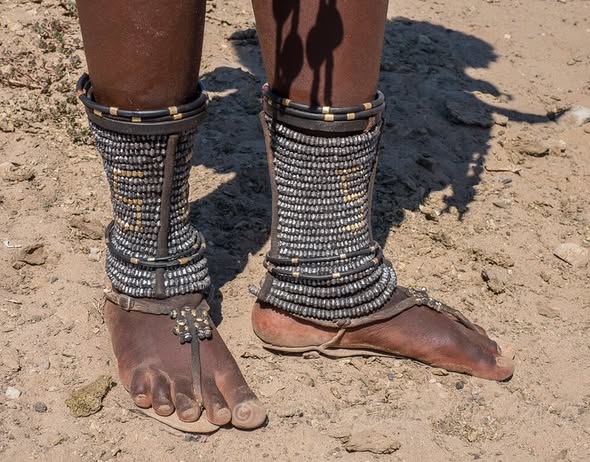
The Himba people of northern Namibia and southern Angola are widely recognized for their striking appearance, ochre tinted skin, and deeply rooted cultural traditions. Every aspect of Himba adornment carries meaning, from hairstyles and body mixtures to jewelry and metalwork. Among their most distinctive ornaments are the heavy iron ankle bracelets worn by Himba women, which are far more than decorative accessories. They represent protection, identity, family status, and cultural pride.
Himba ankle bracelets are traditionally crafted from iron and shaped into thick, solid bands that can appear both powerful and elegant. These bracelets are often worn daily and form an important part of a woman’s visible identity within the community. One of their practical purposes is protection. In the dry bush regions where the Himba live, venomous snakes are a real danger. The weight and thickness of the metal bands provide a degree of physical shielding around the lower legs and ankles, which are especially vulnerable when walking through grass and scrub.
Beyond their protective role, the bracelets carry strong symbolic meaning. They are closely connected to a woman’s social and family status. In many cases, the markings or lines worked into the metal represent the number of children she has. In this way, the bracelets become a living record of motherhood and lineage, quietly communicating personal history without words. They also signal maturity and womanhood, distinguishing adult women from younger girls.
Modesty is another important cultural element reflected in the bracelets. Within Himba tradition, the ankles are considered a private part of the body. Covering them with substantial metal bands aligns with cultural values of dignity and respect. What might seem like ornamentation to an outside observer is, within the culture, a meaningful expression of propriety.
Himba jewelry as a whole functions like a visual language. Alongside ankle bracelets, women wear necklaces, headpieces, and waist ornaments made from shells, copper, beads, leather, and woven reeds. Each material and design can communicate information about age, marital status, clan connection, and stage of life. The combined effect is both beautiful and deeply informative within the community.
For visitors and cultural travelers, seeing traditional Himba adornment offers a powerful reminder that beauty and meaning are closely linked in indigenous cultures. These pieces are not fashion trends but living heritage, passed down through generations and still actively worn today. The ankle bracelets, in particular, stand as a symbol of strength, protection, and identity, grounding Himba women in both tradition and community.